
What are crypto-synthetic assets?
Blockchain-based financial instruments, called crypto-synthetic assets, imitate the value and behavior of actual assets or financial instruments.
Synthetic crypto assets, also known as ‘synthetic assets’, are a class of digital financial instruments created to mimic the value and performance of actual financial or real-world assets, such as stocks, commodities, currencies, or even other cryptocurrencies. without actually owning the underlying assets.
These artificial assets are produced using complex financial derivatives and smart contracts on blockchain platforms, mainly in decentralized finance (DeFi) ecosystems. The ability to create decentralized smart contracts on blockchain systems such as Ethereum, use collateral to secure value, accurately track target asset prices, and create flexible leverage or derivative products are key features of crypto-synthetic assets.
DeFi customers now have access to a wider range of financial markets and assets, reducing their dependence on conventional intermediaries. However, users should exercise caution as these instruments increase complexity and risk, necessitating a thorough understanding of their underlying operation and effects on investment strategies.
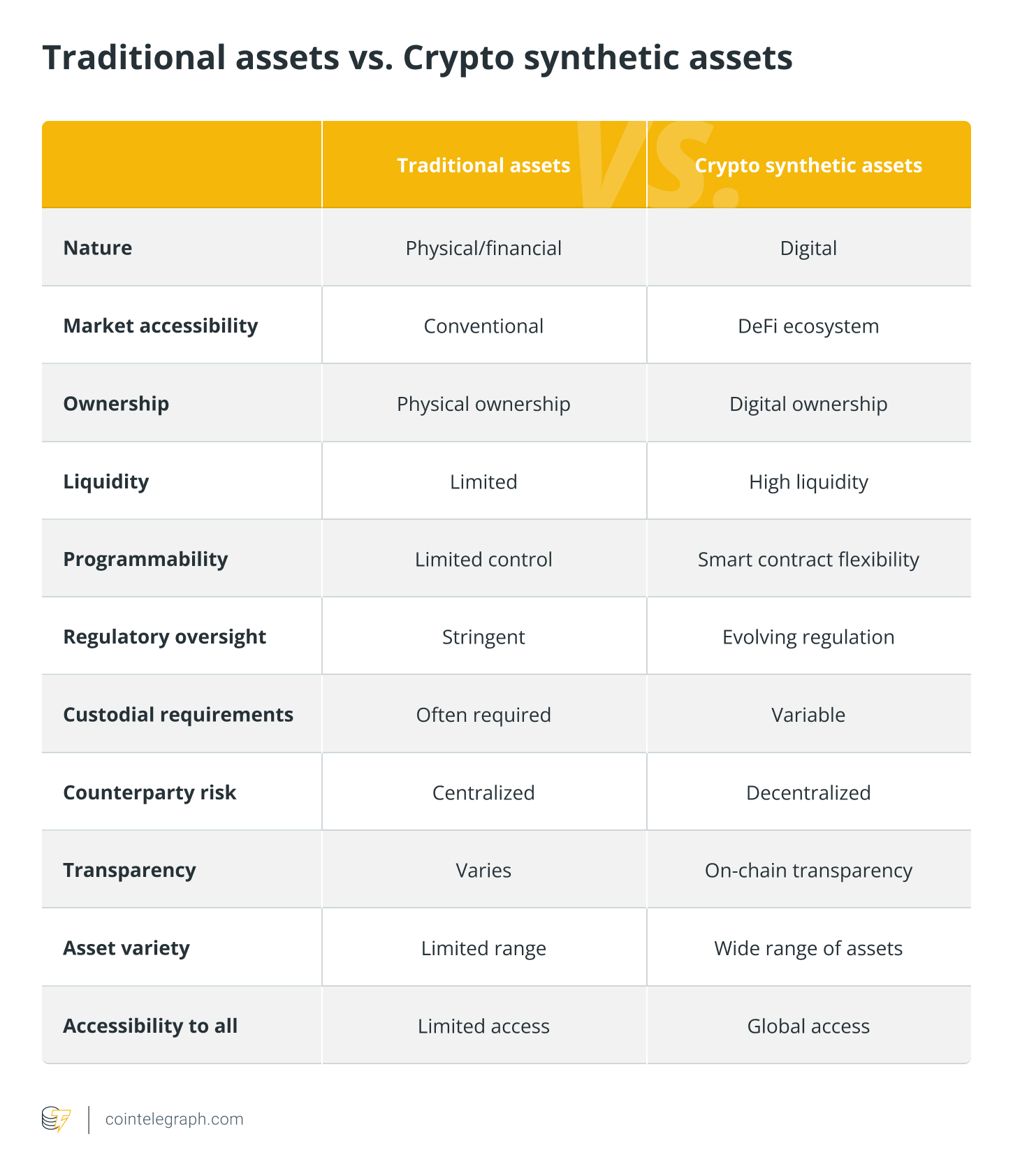
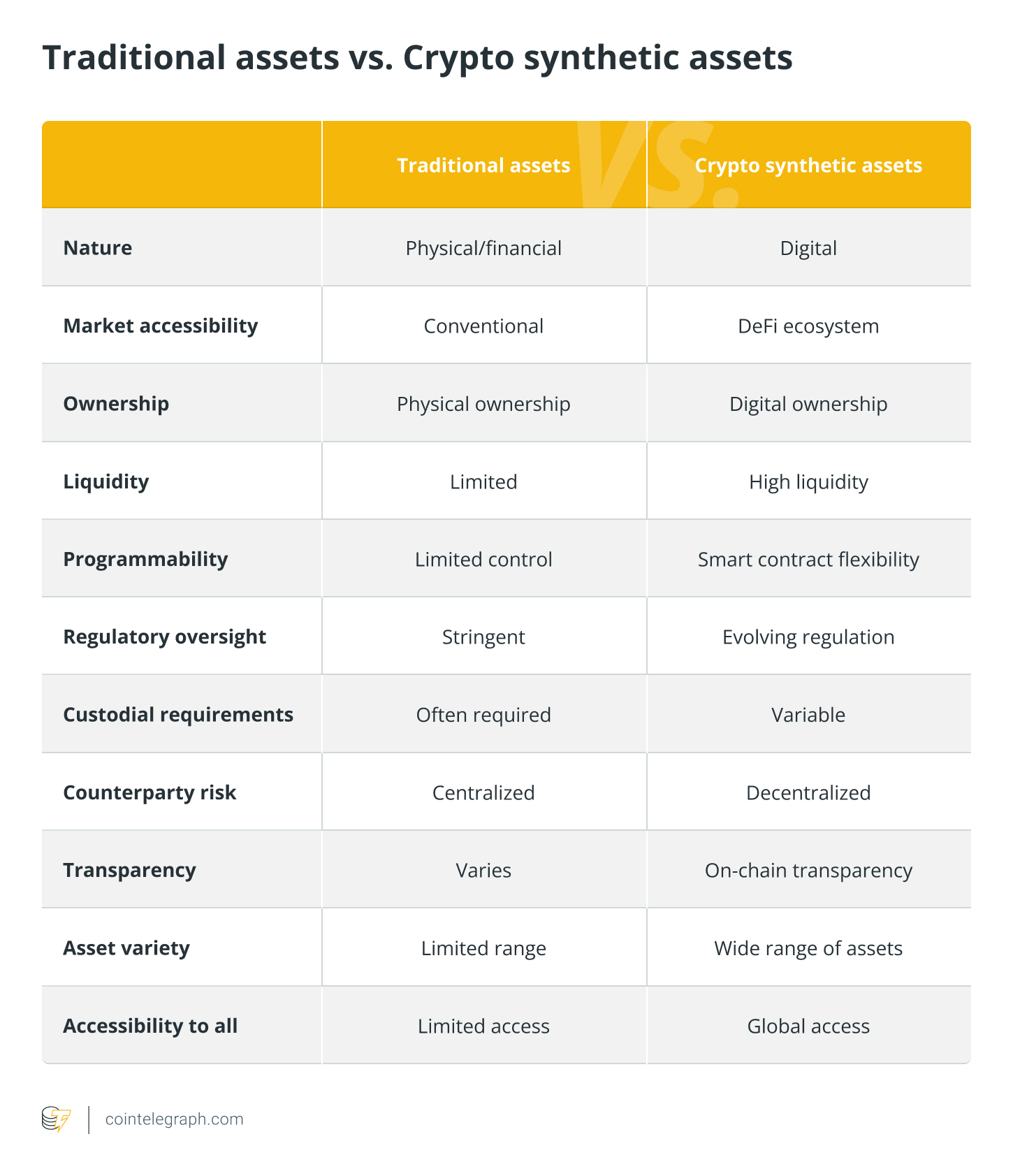
Traditional vs crypto synthetic assets
Traditional assets are tangible or monetary items such as stocks, bonds and commodities that are exchanged in established financial markets. Crypto-synthetic assets, on the other hand, are digital representations built on blockchain technology and intended to match the value and performance of these conventional assets.
The fundamental distinction between traditional and crypto-synthetic assets is that traditional assets are physical or paper-based, while crypto-synthetic assets only exist in digital form on blockchain networks. While synthetic cryptocurrencies have advantages over traditional assets in terms of accessibility, liquidity and programmability, they also come with unique risks and complexities.
Types of Synthetic Crypto Assets
Synthetic crypto assets come in various forms, such as synthetic stablecoins, tokenized commodities and equities, leveraged and inverse tokens, and yield-bearing synthetic assets.
Synthetic stablecoins
Digital tokens, known as synthetic stablecoins, are intended to mimic the value and stability of fiat money, such as the US dollar or the euro. They give people a mechanism to exchange goods and services and store value in the cryptocurrency ecosystem without experiencing the volatility of cryptocurrencies.
An example of a synthetic stablecoin is sUSD, which was developed on the Synthetix platform. It aims to provide users with access to a stable form of digital cash equivalent to the value of the US dollar.
Tokenized commodities and shares
Tokenized commodities and stocks serve as digital representations of real-world assets such as gold, oil, stocks and other commodities on blockchain networks. These synthetic assets enable the decentralized fractional ownership and exchange of conventional assets.
An example of a synthetic asset that tracks the price of crude oil is sOIL, which is also developed on the Synthetix platform. Without actually owning oil, this can leave investors more exposed to price changes.
Leveraged and inverse tokens
Synthetic assets, known as leveraged and inverse tokens, are designed to amplify or counteract the price changes of an underlying asset. Inverse tokens make profits when the price of the underlying asset falls, while leveraged tokens magnify profits and losses.
For example, BTC3L (Binance Leveraged Tokens) seeks to generate daily returns three times higher than the price of Bitcoin (BTC). BTC3L should rise 3% if Bitcoin rises 1%.
Yield-bearing synthetic assets
Within the DeFi ecosystem, yield-bearing synthetic assets offer holders returns through staking or lending, giving them an opportunity to generate passive income.
An example of a synthetic agent is cDAI, developed by the Compound Protocol. Dai (DAI) stablecoins can be given to participate in lending operations on the Compound platform and earn interest. Because cDAI earns interest to holders over time, it qualifies as a yield-bearing synthetic asset.
Applications of crypto-synthetic assets
Synthetic crypto assets can be used by traders looking for higher profits, investors diversifying their holdings or DeFi enthusiasts engaged in yield farming.
Trade and investment opportunities
Synthetic crypto assets provide a gateway to a variety of trading and investment opportunities. They allow traders to engage in leveraged trading, increasing their exposure to market fluctuations and potentially generating greater returns (or losses) than would be possible in more conventional trading.
Furthermore, synthetic assets cover a wide range of underlying assets within the crypto ecosystem, including stocks and commodities, giving investors an easy way to diversify their portfolios.
Yield agriculture and liquidity provision
Users who stake cryptographic synthetic assets in DeFi protocols can engage in yield farming, earning incentives in the form of additional synthetic assets or governance tokens for actively participating in liquidity provision and DeFi operations.
Synthetic assets also significantly increase the liquidity pools and overall liquidity of DeFi platforms, which is essential for facilitating effective trading, lending, and borrowing within the DeFi ecosystem.
Risk management and hedging strategies
Synthetic assets provide powerful risk management tools and hedging capabilities. Traders and investors can use inverse synthetic assets as efficient hedges to protect their portfolios against declines in the underlying assets.
Synthetic stablecoins also provide a decentralized alternative to conventional stablecoins, protecting asset values in the face of the market’s inherent volatility.
Role of DeFi in creating and trading synthetic assets
By allowing users to create, trade and diversify their portfolios with synthetic assets, DeFi is democratizing the financial sector by upending established financial systems and driving financial inclusion worldwide.
The development and trading of synthetic assets is fundamental to changing the conventional financial environment, and DeFi is a key player in this process. DeFi platforms are revolutionizing the way we interact with financial instruments by using blockchain technology and smart contracts to make creating, issuing and trading synthetic assets easy.
First, DeFi eliminates the need for intermediaries, improving accessibility and productivity. Users can issue tokens that replicate the value of real-world assets such as stocks, commodities and fiat currencies by providing cryptocurrencies as collateral.
Second, DeFi’s open and permissionless design drives innovation by allowing programmers to test different synthetic asset designs and trading strategies. By providing consumers with 24/7 access to a wide range of assets, this innovation has democratized access to international markets.
DeFi platforms also offer liquidity pools where users can easily trade synthetic assets. These systems promote yield farming by rewarding users for donating money and participating in the ecosystem.
Benefits of crypto-synthetic assets
Synthetic crypto assets offer a rich range of benefits including diversification, leverage, DeFi involvement, liquidity augmentation and risk mitigation.
Cryptographic synthetic assets bring many benefits to the digital financial space. The ability to provide access to a variety of assets including traditional stocks, commodities and currencies is chief among these benefits, as it allows users to seamlessly diversify their portfolios within the cryptocurrency space, reducing risk and investment strategies are improved.
These assets also open the door to leverage, allowing traders to increase their exposure to asset price volatility and perhaps generate higher returns. They play a crucial role in DeFi, allowing users to actively participate in yield farming and liquidity provision and earn rewards for doing so.
Furthermore, synthetic assets form the basis for liquidity pools, increasing the overall liquidity of DeFi platforms – a crucial component for enabling effective trading and lending activities. These assets also serve as essential risk management tools, giving consumers the skills they need to protect their investments against erratic price fluctuations.
Challenges and risks related to synthetic assets
While synthetic assets offer new opportunities and solutions, they are not without problems and dangers, such as weaknesses in smart contracts, liquidity issues, regulatory unpredictability and oracle-related issues.
The use of synthetic assets in the crypto and blockchain industries poses a number of risks and issues that should be carefully considered. The possibility of shortcomings or exploits of smart contracts, which could lead to significant losses, is one of the biggest concerns. For example, in the infamous DAO attack of 2016, a vulnerability in smart contracts resulted in the theft of approximately $50 million worth of Ether (ETH), underscoring the risks of these complex financial instruments.
Another issue is market liquidity, as some synthetic assets may contain less of it than their real-world counterparts. This could result in price manipulation or slippage during trading, which would affect the stability of the market as a whole.
Moreover, regulatory oversight remains a serious problem as governments around the world struggle to define and control these unique financial products. The ongoing legal disputes and regulatory changes surrounding stablecoins like Tether (USDT) provide an example of the potential legal challenges synthetic assets could face.
Finally, over-reliance on oracle systems, which provide smart contracts with access to real-world data, leads to security risks. For example, if an oracle is compromised, it may serve up incorrect data, which could affect the usefulness and value of artificial resources that depend on it.