
A group of decentralized finance protocols (DeFi) have worked together to solve the liquidity problems in the Cosmos ecosystem. The teams involved include cross-chain bridging protocol Wormhole, liquidity aggregator Swing, lending protocol Tashi and Cosmos network Evmos.
According to statements from two of the teams involved, Wormhole will register five new bridged tokens for use on Evmos: Tether (USDT), USD Coin (USDC), wrapped Ether (wETH), wrapped Bitcoin (wBTC), and Solana (SOL). A Wormhole board vote on this part of the proposal began on September 19 and currently has near-unanimous support.
Once the tokens are launched on Evmos, they will be implemented in the Swing protocol, allowing users to send them to Evmos from any network that supports Swing, including BNB Chain, Polygon, Fantom and others.
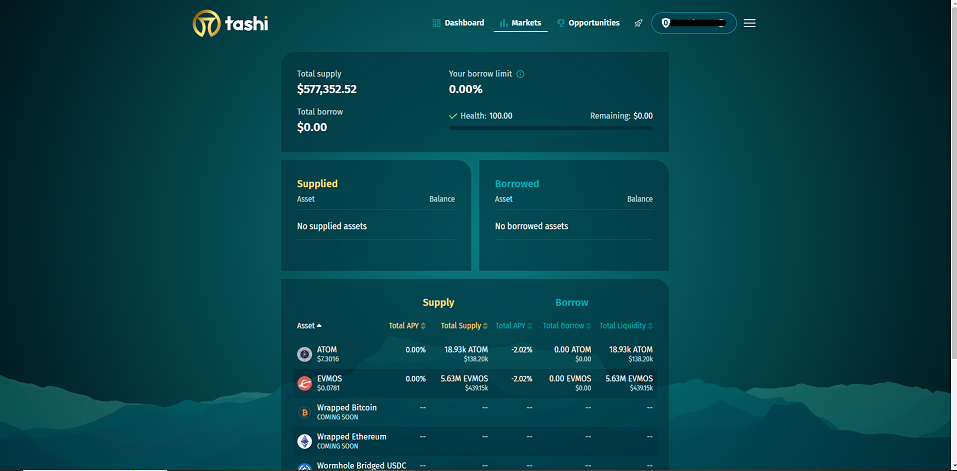
Tashi will also implement Swing into its user interface, allowing users to bridge and deposit the coins as collateral with a minimum of button clicks. Users can then take loans from Cosmos-based or Ethereum-based coins using this collateral, exchange the borrowed coins for others, deposit them into liquidity pools, or perform other common DeFi actions.
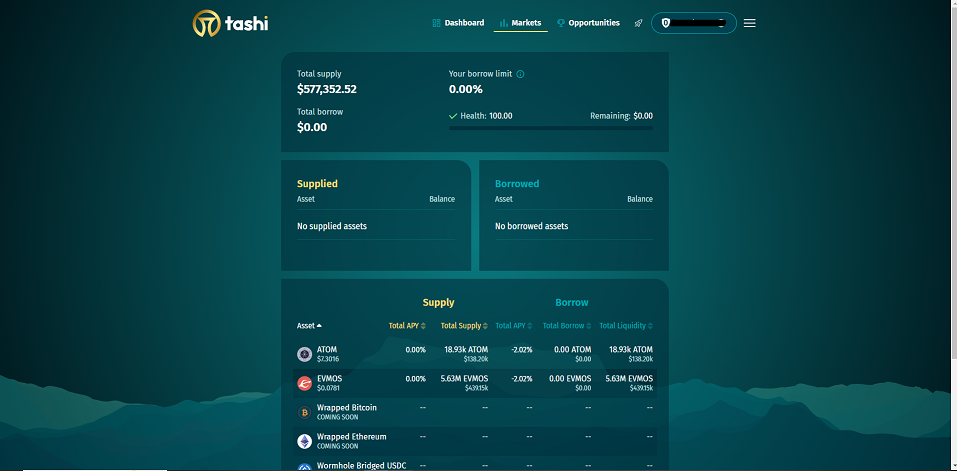
Caption: Tashi user interface. Source: Tashi.
According to representatives from both Swing and Tashi, the integrations are ready to go live and are simply waiting for the Wormhole proposal to be adopted and implemented. The vote on the proposal ends on September 24, implying that the new liquidity system should go live shortly afterwards.
Related: DYdX launches decentralized order book exchange on Cosmos: KBW 2023
Speaking to Cointelegraph, Tashi co-founders Lindsay Ironside and Kristine Boulton claimed that the new system is needed to solve a “crisis” in liquidity within the Cosmos ecosystem. “We have a chain that continues to offer these great opportunities, but no one is taking advantage of them because they can’t get liquidity there,” Boulton said. But “[Wormhole]they’re on, I think it’s 29 different chains right now […] so it is an opportunity to solve that crisis.”
Ironside stated that she felt a new system was needed after she first started using the Cosmos ecosystem. She had a bad user experience when she first tried to exchange USDC for Cosmos (ATOM) and send it to Evmos. To obtain the ATOM, she first had to bridge her USDC to Cosmos Hub. But once the USDC was on the network, it no longer had the ATOM to pay the gas fee to make the exchange.
According to Ironside, this experience made her realize that the team needed to focus on this problem. “I come in as new users […] and trying to find out where the solutions to these problems lay, [that] was a big deal,” she noted.
In a separate conversation, Swing CEO Viveik Vivekananthan agreed that the new system may solve these problems. If a user wants to exchange USDC for another coin on Evmos, Swing will convert a small portion of the sent coins into Evmos’ native coin, which is then spent on gas to make the exchange. This will allow users to get into Evmos with any supported coin, Vivekananthan explains.
Initially, Swing will only be able to bridge tokens from primarily non-Cosmos networks to Evmos, he said, but the team plans to expand compatibility to enable bridges between different Cosmos networks in the future.
The Cosmos community has made a concerted effort to attract users with new features in 2023. Cosmos-based chain Noble launched a native version of the USDC stablecoin on March 28, and Cosmos Hub implemented liquid staking on September 13. However, the ecosystem has also faced a competitor in the form of the Optimism Superchain, which attempts to build an interconnected web of blockchains with similar features to Cosmos.